We value thought-leadership at Fortuna Cysec
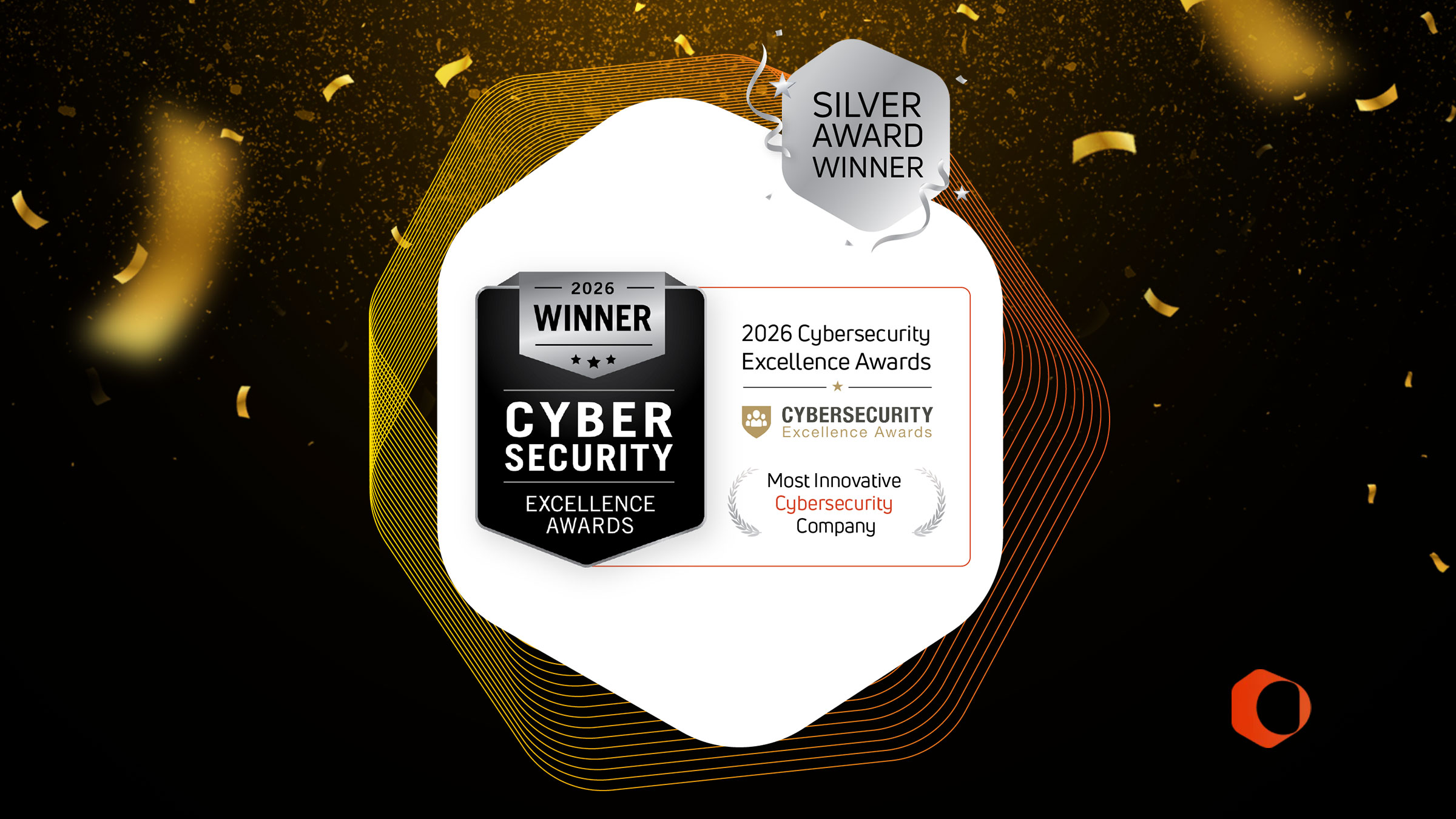
ATLANTA, Sep. 08, 2026 -- Fortuna Cysec, a global cybersecurity company offering integrated AI-native security operations managed detection and response, continuous threat exposure management and compliance services, today announced it has been named a Silver Award recipient in the “Most Innovative Cybersecurity Company” category of the 2026 Cybersecurity Excellence Awards, recognizing the company's commitment to advancing cybersecurity innovation and helping organizations achieve measurable security outcomes.
The Cybersecurity Excellence Awards honor outstanding achievement across cybersecurity companies, products, services, professionals, and industry solutions, celebrating the people and organizations delivering measurable innovation across the cybersecurity market. Fortuna Cysec was recognized for its continued innovation through its Fortunox platform and its ability to help organizations navigate increasingly complex cyber threats, compliance requirements and security resource constraints.
“We congratulate Fortuna Cysec for Silver Award recognition in the Most Innovative Cybersecurity Company category of the 2026 Cybersecurity Excellence Awards,” said Holger Schulze, founder of Cybersecurity Insiders and organizer of the Cybersecurity Excellence Awards. “Selected by an independent jury of cybersecurity practitioners, analysts, and CISOs, this recognition highlights meaningful contributions that strengthen cybersecurityacross organizations worldwide.”
A key differentiator of Fortuna Cysec's approach is its ability to combine technology, expert talent and proven processes into a fully managed security operating model. Built around an identity-centric architecture, Fortunox delivers continuous monitoring, threat detection, incident response, remediation support, compliance reporting and executive risk insight through a single integrated platform. Fortuna Cysec supports organizations globally across highly regulated industries like financial services, healthcare, insurance and advanced manufacturing.
“We are honored to be awarded the Most Innovative Cybersecurity Company from the Cybersecurity Excellence Awards,” said Navin Balakrishnaraja, CEO and co-founder of Fortuna Cysec. “This recognition reflects our team's dedication to helping organizations move beyond fragmented security tools and toward modern, measurable security outcomes. Through continuous innovation in the Fortunox platform, AI-driven security operations and compliance-focused managed services, we remain committed tohelping our clients reduce risk, strengthen resilience and build long-term cybersecurity maturity.”
This recognition further underscores Fortuna Cysec's mission to deliver practical, outcome-focused cybersecurity through an integrated platform that combines AI-powered threat detection, automated response, compliance management and 24x7 managed security operations.
About Fortuna Cysec
Fortuna Cysec is a global cybersecurity company offering Fortunox - an integrated AI-native Security Operations Platform that centralizes AI-powered threat detection, automated response, compliance management and true 24x7 managed detection and response. By combining advanced analytics, automated actions and expert-led response in one integrated system, Fortuna Cysec gives organizations a faster, smarter and more resilient way to defend their environments. For more information, visit www.fortunacysec.com.
Fortuna Cysec Named Silver Award Winner for Most Innovative Cybersecurity Company in the 2026 Cybersecurity Excellence Awards
Fortuna Cysec Named Silver Award Winner for Most Innovative Cybersecurity Company in the 2026 Cybersecurity Excellence Awards
ATLANTA, Aug. 18, 2026 -- Fortuna Cysec, a global cybersecurity company offering integrated AI-native security operations managed detection and response, continuous threat exposure management and compliance services, has been recognized as a finalist by CRN®, a brand of The Channel Company, for its second annual CRN Best of the Channel Awards in category of the “Best Security Solution Provider of the Year.”
As a finalist, Fortuna Cysec is being spotlighted for its dedication to channel innovation and excellence through helping organizations across multiple regulated and risk-sensitive sectors with their managed security, risk mitigation, compliance advisory, incident response, vulnerability management, and security operations services.
As a global security-first solution provider, Fortuna Cysec allows organizations overwhelmed by disconnected products, alert fatigue, compliance obligations, and limited internal security resources to move beyond fragmented security tools towards measurable security outcomes. Its integrated AI-native Security Operations Platform Fortunox, offers a unified, managed approach to cybersecurity by combining visibility, detection, response, remediation, compliance reporting, and executive-level risk insight into asingle operating model. This includes 24X7 managed detection and response, Continuous Threat Exposure Management (CTEM) and compliance services, supporting both technical execution and risk guidance needs.
The CRN Best of the Channel Awards honors individual leaders, teams, and companies setting an example with theirvisionary strategies and outstanding contributions to channel success.
“The finalists of the CRN Best of the Channel Awards represent the very best of the IT channel," said Jennifer Follett, VP, U.S. Content and Executive Editor of CRN, The Channel Company. "Through innovation, exceptional leadership, and an unwavering commitmentto partners and customers, these individuals, teams, and companies are helping shape the future of the channel. We are proud to recognize their accomplishments and the lasting impact they continue to make across the industry."
“We are honored to be recognized as a finalist among such an impressive group of innovators,” said Navin Balakrishnaraja, CEO and co-founder of Fortuna Cysec. “This recognition highlights the strength of our platform and our team’s commitment to helping clients reduce risk, strengthen resilience, and mature their security and compliance programs.”
Winners will be announced at the Best of the Channel Awards Gala in Atlanta on Oct. 13, immediately following The Channel Company’s XChange Best of Breed Conference. To see the full list of CRN Best of the Channel Award finalists, visit crn.com/best-of-the-channel-awards.
About Fortuna Cysec
Fortuna Cysec is a global cybersecurity company offering Fortunox - an integrated AI-native Security Operations Platform that centralizes AI-powered threat detection, automated response, compliance management and true 24x7 managed detection and response. By combining advanced analytics, automated actions and expert-led response in one integrated system, Fortuna Cysec gives organizations a faster, smarter and more resilient way to defend their environments. For more information, visit www.fortunacysec.com.
About The Channel Company
The Channel Company (TCC) is the global leader in channel growth for the world's top technology brands. We accelerate success across strategic channels for tech vendors, solution providers, and end users with premier media brands, integrated marketing and event services, strategic consulting, and exclusive market and audience insights. TCC is a portfolio company of investment funds managed by Eagle Tree Capital, a New York City-based private equity firm. For more information, visit thechannelco.com.
FollowThe Channel Company: LinkedIn, X
©2026 The Channel Company, Inc. The Channel Company logo is a registeredtrademark of The Channel Company, Inc. All other trademarks and trade names arethe properties of their respective owners. All rights reserved.
The Channel Company Contact:
Lindsay Sawyer, The Channel Company lsawyer@thechannelcompany.com
Fortuna Cysec Named a CRN’s 2026 Best of the Channel Awards Finalist for Best Security Solution Provider of the Year
Fortuna Cysec Named a CRN’s 2026 Best of the Channel Awards Finalist for Best Security Solution Provider of the Year

ATLANTA, Aug. 6, 2026 -- Fortuna Cysec, a global cybersecurity company offering integrated AI-native security operations managed detection and response, continuous threat exposure management and compliance services, today announced the appointment of Srinivas Pendela as Vice President of Service Delivery, reinforcing the company's commitment to delivering exceptional customer outcomes, operational excellence, and scalable cybersecurity and managed services worldwide.
A proven technology leader, Srinivas Pendelabrings more than 21 years of experience in infrastructure, cloud,cybersecurity, and IT service operations, leading global service delivery andtransformation initiatives across North America, Europe, Canada, and India. Risingfrom network engineer to senior technology executive, he has successfully ledlarge-scale 24x7 operations, cross-functional teams, and enterprise servicedelivery programs spanning cloud, infrastructure, cybersecurity, automation,digital transformation, customer success, and presales strategy. Throughout hiscareer, he has driven multimillion-dollar digital transformation and managedservices programs while championing AI-driven automation initiatives thatimproved operational efficiency and enhanced service delivery.
“I’m excited to join Fortuna Cysec at such apivotal time in its growth journey," said Pendela. “Organizations todayare looking for trusted partners that can help them navigate increasinglycomplex cybersecurity challenges while maximizing the value of their technologyinvestments. I look forward to working with our talented team to furtherelevate service delivery, strengthen customer relationships, and buildscalable, innovative solutions that help our clients achieve their security andbusiness objectives."
In his new role, Srinivas will help lead andscale Fortuna Cysec's service delivery organization, enhancing operationalexcellence, customer outcomes, and service innovation as the company continuesto expand its global footprint. His leadership will support Fortuna Cysec'sgrowing portfolio of cybersecurity consulting, managed security services, andAI-powered solutions, enabling organizations to strengthen security operations,reduce cyber risk, and improve resilience.
“Srinivas brings a rare combination ofoperational excellence, technical expertise, and customer-first leadership thataligns perfectly with our vision,” said Navin Balakrishnaraja, CEO andco-founder of Fortuna Cysec. “As we continue expanding our cybersecuritysolutions, his experience leading global teams and driving servicetransformation will be instrumental in helping us scale efficiently, accelerateinnovation, and deliver even greater value to our customers. We are thrilled towelcome him to the leadership team.”
This announcement follows Fortuna Cysec’srecent enhancements to Fortunox, thecompany’s unified, configurable, managed cybersecurity platform designed forregulated industries that centralizes an organization's security posture forall assets across all locations. The latest enhancements are helping organizationsmore effectively operationalize their Continuous Threat Exposure Management(CTEM) while maximizing the value of existing security investments and tools.
About Fortuna Cysec
Fortuna Cysec is a global cybersecurity companyoffering Fortunox - an integrated AI-native Security Operations Platform thatcentralizes AI-powered threat detection, automated response, compliancemanagement and true 24x7 managed detection and response. By combining advancedanalytics, automated actions and expert‑led response in one integrated system,Fortuna Cysec gives organizations a faster, smarter andmore resilient way to defend their environments. For more information, visit www.fortunacysec.com.
Fortuna Cysec Appoints Srinivas Pendela as Vice President of Service Delivery to Accelerate Global Growth and Customer Success
Fortuna Cysec Appoints Srinivas Pendela as Vice President of Service Delivery to Accelerate Global Growth and Customer Success

For years, many organizations have relied on their Managed Service Provider to keep their technology running. MSPs handle helpdesk tickets, device management, patching, Microsoft 365 administration, backups, networking, and the day-to-day operational needs that keep a business moving.
But cybersecurity has changed.
Today’s threats move faster, target more parts of the environment, and require deeper expertise than traditional IT support alone was designed to provide. As a result, many MSPs eventually reach a point where they realize they need help. They acknowledge that they are not a 24×7 security operations center, so they outsource security monitoring to a third-party MSSP or SOC provider.
On the surface, that sounds like the right move.
In practice, the standard MSP/MSSP relationship often creates a dangerous gap for the end customer.
The Problem With the Traditional MSP/MSSP Model
The typical model looks like this:
- The MSP manages the client’s IT environment.
- The MSSP monitors alerts.
- The SOC detects, correlates, and validates threats.
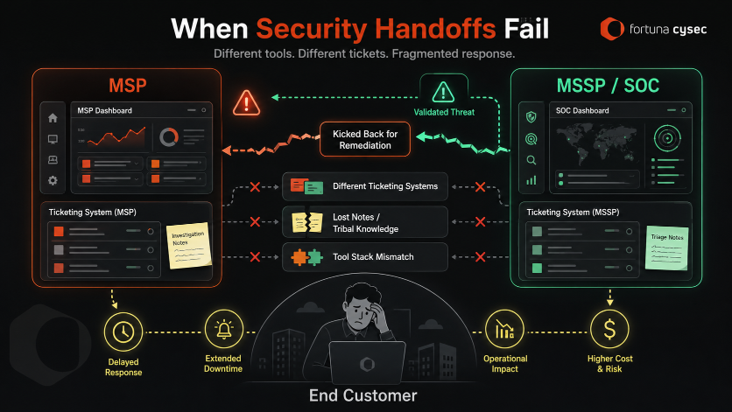
- Then, when something is confirmed, the issue is often handed back to the MSP to fix.
- That handoff is where the problem begins.
The MSP already recognized that security was not their strongest capability. That is why they outsourced SOC services in the first place. But when a real incident occurs, when the threat is active, the environment is under pressure, and speed matters most, the responsibility frequently shifts back to the same team that admitted they needed outside security support.
That creates a critical issue at a critical time.
Detection alone is not enough. Correlation alone is not enough. Even response alone may not be enough if the team responsible for remediation does not understand the security context, business impact, root cause, and urgency behind the threat.
The result is often delay, confusion, and incomplete resolution.
The Handoff Problem Is Bigger Than Most Customers Realize
One of the biggest deficiencies in the traditional MSP/MSSP model is that the handoff is rarely seamless.
- The MSP may live in one ticketing system.
- The MSSP may operate in another.
- The customer may have their own system entirely.
When those systems are not tightly integrated, critical handling notes, escalation history, environmental details, and tribal knowledge do not move cleanly between teams. The SOC may validate a threat but lack visibility into previous issues on that device. The MSP may receive a ticket but not fully understand the investigation trail, the severity rationale, or the attacker behavior that triggered the escalation.
This matters because during a security event, context is everything.
A note buried in one system may explain that a server supports a critical business unit. A previous ticket may reveal that a device has recurring patch failures. A technician may know that a certain user travels frequently, works remotely, or has privileged access. A SOC analyst may know that an alert is tied to a broader attack pattern.
When that information is scattered across separate systems and separate teams, the customer loses speed and clarity at the exact moment they need both.
This creates a security model built around ticket passing instead of risk reduction.
Tool Stack Lock-In Creates Another Problem
The other challenge is the tool stack.
In many MSP/MSSP relationships, the customer is forced into whatever security tools the MSP or MSSP has already selected. The model is built around provider convenience, not necessarily customer need.
That may create operational efficiency for the provider, but it can create limitations for the customer.
- The MSP may only support certain endpoint tools.
- The MSSP may only monitor certain logs.
- The SOC may only integrate with a preferred SIEM, EDR, or ticketing platform.
- The customer’s existing investments may be ignored, replaced, or underutilized.
This can leave organizations trapped in an inflexible model where their actual business needs are not fully surfaced. Instead of asking, “What does this customer need based on their risk, operations, compliance requirements, and maturity level?” the model becomes, “Here is the stack we use, and here is how you fit into it.”
That is backwards.
Security tools should support the customer’s operating model. The customer should not have to reshape their security program around the limitations of disconnected providers.
A stronger model should be flexible enough to work with the customer’s environment, integrate with the tools that already matter, and recommend changes based on risk and maturity — not just vendor preference.
The End Customer Pays the Price
From the end customer’s perspective, this fragmented model can be frustrating and risky.
- One provider sees the alert.
- Another provider manages the endpoint.
- Another team owns the firewall.
- A different ticketing system holds the notes.
- A separate platform contains the security investigation.
- The business leader just wants to know: are we safe, what happened, what matters, and what are we doing about it?
When security responsibility is split across disconnected teams, the customer is left managing the seams between providers. During a normal support issue, that may be inefficient. During a cyber event, it can be dangerous.
Common failure points include:
- Delayed remediation because the SOC identifies the issue but does not own the fix.
- Incomplete response because the MSP receives an alert without enough security context.
- Lost tribal knowledge because ticketing systems, notes, and escalation histories are not shared effectively.
- Tool limitations because the customer is forced into a provider-selected stack instead of a model built around their needs.
- Poor prioritization because neither party fully understands which systems, users, data, or business units matter most.
- Recurring incidents because the immediate threat is closed, but the root cause is never fully addressed.
- Executive confusion because reporting focuses on alerts and tickets instead of risk reduction, resilience, and business impact.
This is how organizations end up with activity but not maturity. Lots of alerts. Lots of tickets. Lots of dashboards. But not enough actual reduction in exposure, risk, or threat impact.
Security Requires Environmental Intimacy
Strong cybersecurity is not just about tools. It is not just about having a SOC. It is not just about alert triage.
It requires intimacy with the environment.
A mature security partner should understand your infrastructure, users, business units, critical systems, sensitive data, compliance obligations, operational workflows, and risk tolerance. They should know what matters most to the business, not just what appears most severe in a generic alert queue.
That context changes everything.
A vulnerability on a dormant test system is different from a vulnerability on a system that supports patient care, financial transactions, manufacturing operations, or executive communications. A suspicious login from a normal user is different from a suspicious login from a privileged administrator. A malware alert on a standard workstation is different from an alert tied to a device with access to regulated data.
Without business context, security teams can only react to technical signals.
With business context, they can prioritize, respond, remediate, and mature the environment over time.
The Goal Should Be Maturity, Not Just Monitoring
Many organizations think they are buying security when they purchase SOC monitoring. What they are often buying is visibility into potential threats.
Visibility is important, but it is only the starting point.
The real goal should be to raise the organization’s security maturity level. That means reducing the number of recurring issues, improving response readiness, hardening weak points, prioritizing risk based on business impact, and helping leadership make better decisions.
A mature security operating model should include:
- Continuous visibility across assets, users, vulnerabilities, identities, systems, and sensitive data.
- Risk-based prioritization that goes beyond alert severity or CVSS scores.
- Shared operational context across security, IT, ticketing, remediation, and reporting workflows.
- Flexible tool integration that supports the customer’s environment instead of forcing the customer into a rigid provider stack.
- Coordinated response that connects detection, investigation, containment, remediation, and validation.
- Root-cause analysis to understand why an incident happened and how to prevent it from recurring.
- Executive-level reporting that shows risk reduction, operational improvement, and business impact.
- Remediation support so the customer is not left holding the bag after an alert is validated.
That is the difference between a vendor that watches your environment and a partner that helps improve it.
Either You Need a New Integrated Partner, or Your MSP Does
This does not mean MSPs are the problem. Many MSPs are excellent operational technology partners. They are close to their clients, understand day-to-day IT needs, and play an essential role in keeping businesses running.
But the traditional MSP/MSSP handoff model is no longer enough.
If your MSP is not built to deliver mature cybersecurity outcomes, they need an integrated security partner behind them. If your current provider structure creates handoffs, disconnected ticketing, lost tribal knowledge, tool limitations, or delayed remediation during security events, then your business may need a new model altogether.
The best outcome is not an MSP on one side and an MSSP on the other, with the customer stuck in the middle.
The best outcome is an integrated operating model where security expertise, IT context, remediation capability, business risk awareness, ticketing visibility, and tool flexibility work together.
- That is how organizations reduce threat impact.
- That is how they mature their security program.
- That is how they move from reactive support to resilient operations.
Because when something happens, the question should not be, “Who owns this?”
The answer should already be clear.
Either You Need a New Integrated Partner, or Your MSP Does
An examination of how disconnected MSP and MSSP relationships create dangerous security gaps—and why organizations need an integrated partner that connects detection, remediation, business context, and accountability.