5 MIN READ

Either You Need a New Integrated Partner, or Your MSP Does

For years, many organizations have relied on their Managed Service Provider to keep their technology running. MSPs handle helpdesk tickets, device management, patching, Microsoft 365 administration, backups, networking, and the day-to-day operational needs that keep a business moving.

But cybersecurity has changed.

Today’s threats move faster, target more parts of the environment, and require deeper expertise than traditional IT support alone was designed to provide. As a result, many MSPs eventually reach a point where they realize they need help. They acknowledge that they are not a 24×7 security operations center, so they outsource security monitoring to a third-party MSSP or SOC provider.

On the surface, that sounds like the right move.

In practice, the standard MSP/MSSP relationship often creates a dangerous gap for the end customer.

The Problem With the Traditional MSP/MSSP Model

The typical model looks like this:

  • ­The MSP manages the client’s IT environment.
  • ­The MSSP monitors alerts.
  • ­The SOC detects, correlates, and validates threats.
  • ­Then, when something is confirmed, the issue is often handed back to the MSP to fix.
  • That handoff is where the problem begins.

The MSP already recognized that security was not their strongest capability. That is why they outsourced SOC services in the first place. But when a real incident occurs, when the threat is active, the environment is under pressure, and speed matters most, the responsibility frequently shifts back to the same team that admitted they needed outside security support.

That creates a critical issue at a critical time.

Detection alone is not enough. Correlation alone is not enough. Even response alone may not be enough if the team responsible for remediation does not understand the security context, business impact, root cause, and urgency behind the threat.

The result is often delay, confusion, and incomplete resolution.

The Handoff Problem Is Bigger Than Most Customers Realize

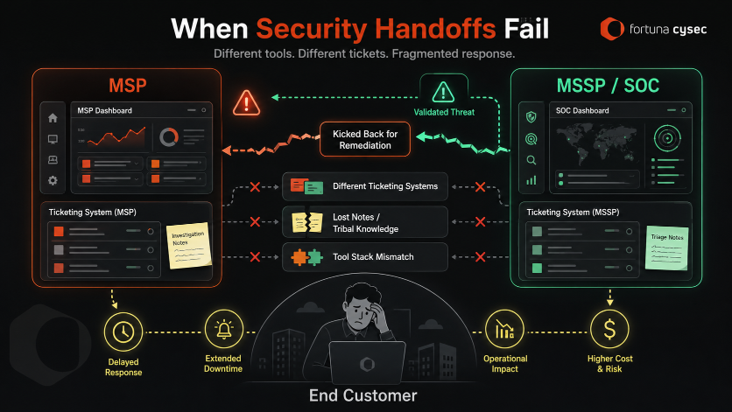
One of the biggest deficiencies in the traditional MSP/MSSP model is that the handoff is rarely seamless.

  • ­The MSP may live in one ticketing system.
  • ­The MSSP may operate in another.
  • ­The customer may have their own system entirely.

When those systems are not tightly integrated, critical handling notes, escalation history, environmental details, and tribal knowledge do not move cleanly between teams. The SOC may validate a threat but lack visibility into previous issues on that device. The MSP may receive a ticket but not fully understand the investigation trail, the severity rationale, or the attacker behavior that triggered the escalation.

This matters because during a security event, context is everything.

A note buried in one system may explain that a server supports a critical business unit. A previous ticket may reveal that a device has recurring patch failures. A technician may know that a certain user travels frequently, works remotely, or has privileged access. A SOC analyst may know that an alert is tied to a broader attack pattern.

When that information is scattered across separate systems and separate teams, the customer loses speed and clarity at the exact moment they need both.

This creates a security model built around ticket passing instead of risk reduction.
Tool Stack Lock-In Creates Another Problem

The other challenge is the tool stack.

In many MSP/MSSP relationships, the customer is forced into whatever security tools the MSP or MSSP has already selected. The model is built around provider convenience, not necessarily customer need.

That may create operational efficiency for the provider, but it can create limitations for the customer.

  • ­The MSP may only support certain endpoint tools.
  • ­The MSSP may only monitor certain logs.
  • ­The SOC may only integrate with a preferred SIEM, EDR, or ticketing platform.
  • ­The customer’s existing investments may be ignored, replaced, or underutilized.

This can leave organizations trapped in an inflexible model where their actual business needs are not fully surfaced. Instead of asking, “What does this customer need based on their risk, operations, compliance requirements, and maturity level?” the model becomes, “Here is the stack we use, and here is how you fit into it.”

That is backwards.

Security tools should support the customer’s operating model. The customer should not have to reshape their security program around the limitations of disconnected providers.

A stronger model should be flexible enough to work with the customer’s environment, integrate with the tools that already matter, and recommend changes based on risk and maturity — not just vendor preference.

The End Customer Pays the Price

From the end customer’s perspective, this fragmented model can be frustrating and risky.

  • ­One provider sees the alert.
  • ­Another provider manages the endpoint.
  • ­Another team owns the firewall.
  • ­A different ticketing system holds the notes.
  • ­A separate platform contains the security investigation.
  • ­The business leader just wants to know: are we safe, what happened, what matters, and what are we doing about it?

When security responsibility is split across disconnected teams, the customer is left managing the seams between providers. During a normal support issue, that may be inefficient. During a cyber event, it can be dangerous.

Common failure points include:

  • Delayed remediation because the SOC identifies the issue but does not own the fix.
  • Incomplete response because the MSP receives an alert without enough security context.
  • Lost tribal knowledge because ticketing systems, notes, and escalation histories are not shared effectively.
  • Tool limitations because the customer is forced into a provider-selected stack instead of a model built around their needs.
  • Poor prioritization because neither party fully understands which systems, users, data, or business units matter most.
  • Recurring incidents because the immediate threat is closed, but the root cause is never fully addressed.
  • Executive confusion because reporting focuses on alerts and tickets instead of risk reduction, resilience, and business impact.

This is how organizations end up with activity but not maturity. Lots of alerts. Lots of tickets. Lots of dashboards. But not enough actual reduction in exposure, risk, or threat impact.

Security Requires Environmental Intimacy

Strong cybersecurity is not just about tools. It is not just about having a SOC. It is not just about alert triage.

It requires intimacy with the environment.

A mature security partner should understand your infrastructure, users, business units, critical systems, sensitive data, compliance obligations, operational workflows, and risk tolerance. They should know what matters most to the business, not just what appears most severe in a generic alert queue.

That context changes everything.

A vulnerability on a dormant test system is different from a vulnerability on a system that supports patient care, financial transactions, manufacturing operations, or executive communications. A suspicious login from a normal user is different from a suspicious login from a privileged administrator. A malware alert on a standard workstation is different from an alert tied to a device with access to regulated data.

Without business context, security teams can only react to technical signals.

With business context, they can prioritize, respond, remediate, and mature the environment over time.

The Goal Should Be Maturity, Not Just Monitoring

Many organizations think they are buying security when they purchase SOC monitoring. What they are often buying is visibility into potential threats.

Visibility is important, but it is only the starting point.

The real goal should be to raise the organization’s security maturity level. That means reducing the number of recurring issues, improving response readiness, hardening weak points, prioritizing risk based on business impact, and helping leadership make better decisions.

A mature security operating model should include:

  • Continuous visibility across assets, users, vulnerabilities, identities, systems, and sensitive data.
  • Risk-based prioritization that goes beyond alert severity or CVSS scores.
  • Shared operational context across security, IT, ticketing, remediation, and reporting workflows.
  • Flexible tool integration that supports the customer’s environment instead of forcing the customer into a rigid provider stack.
  • Coordinated response that connects detection, investigation, containment, remediation, and validation.
  • Root-cause analysis to understand why an incident happened and how to prevent it from recurring.
  • Executive-level reporting that shows risk reduction, operational improvement, and business impact.
  • Remediation support so the customer is not left holding the bag after an alert is validated.

That is the difference between a vendor that watches your environment and a partner that helps improve it.

Either You Need a New Integrated Partner, or Your MSP Does

This does not mean MSPs are the problem. Many MSPs are excellent operational technology partners. They are close to their clients, understand day-to-day IT needs, and play an essential role in keeping businesses running.

But the traditional MSP/MSSP handoff model is no longer enough.

If your MSP is not built to deliver mature cybersecurity outcomes, they need an integrated security partner behind them. If your current provider structure creates handoffs, disconnected ticketing, lost tribal knowledge, tool limitations, or delayed remediation during security events, then your business may need a new model altogether.

The best outcome is not an MSP on one side and an MSSP on the other, with the customer stuck in the middle.

The best outcome is an integrated operating model where security expertise, IT context, remediation capability, business risk awareness, ticketing visibility, and tool flexibility work together.

  • That is how organizations reduce threat impact.
  • ­That is how they mature their security program.
  • ­That is how they move from reactive support to resilient operations.

Because when something happens, the question should not be, “Who owns this?”

The answer should already be clear.
Patrick H Whelan
VP of Sales
Published on  
June 24, 2026
Table of Contents

For years, many organizations have relied on their Managed Service Provider to keep their technology running. MSPs handle helpdesk tickets, device management, patching, Microsoft 365 administration, backups, networking, and the day-to-day operational needs that keep a business moving.

But cybersecurity has changed.

Today’s threats move faster, target more parts of the environment, and require deeper expertise than traditional IT support alone was designed to provide. As a result, many MSPs eventually reach a point where they realize they need help. They acknowledge that they are not a 24×7 security operations center, so they outsource security monitoring to a third-party MSSP or SOC provider.

On the surface, that sounds like the right move.

In practice, the standard MSP/MSSP relationship often creates a dangerous gap for the end customer.

The Problem With the Traditional MSP/MSSP Model

The typical model looks like this:

  • ­The MSP manages the client’s IT environment.
  • ­The MSSP monitors alerts.
  • ­The SOC detects, correlates, and validates threats.
  • ­Then, when something is confirmed, the issue is often handed back to the MSP to fix.
  • That handoff is where the problem begins.

The MSP already recognized that security was not their strongest capability. That is why they outsourced SOC services in the first place. But when a real incident occurs, when the threat is active, the environment is under pressure, and speed matters most, the responsibility frequently shifts back to the same team that admitted they needed outside security support.

That creates a critical issue at a critical time.

Detection alone is not enough. Correlation alone is not enough. Even response alone may not be enough if the team responsible for remediation does not understand the security context, business impact, root cause, and urgency behind the threat.

The result is often delay, confusion, and incomplete resolution.

The Handoff Problem Is Bigger Than Most Customers Realize

One of the biggest deficiencies in the traditional MSP/MSSP model is that the handoff is rarely seamless.

  • ­The MSP may live in one ticketing system.
  • ­The MSSP may operate in another.
  • ­The customer may have their own system entirely.

When those systems are not tightly integrated, critical handling notes, escalation history, environmental details, and tribal knowledge do not move cleanly between teams. The SOC may validate a threat but lack visibility into previous issues on that device. The MSP may receive a ticket but not fully understand the investigation trail, the severity rationale, or the attacker behavior that triggered the escalation.

This matters because during a security event, context is everything.

A note buried in one system may explain that a server supports a critical business unit. A previous ticket may reveal that a device has recurring patch failures. A technician may know that a certain user travels frequently, works remotely, or has privileged access. A SOC analyst may know that an alert is tied to a broader attack pattern.

When that information is scattered across separate systems and separate teams, the customer loses speed and clarity at the exact moment they need both.

This creates a security model built around ticket passing instead of risk reduction.

Tool Stack Lock-In Creates Another Problem

The other challenge is the tool stack.

In many MSP/MSSP relationships, the customer is forced into whatever security tools the MSP or MSSP has already selected. The model is built around provider convenience, not necessarily customer need.

That may create operational efficiency for the provider, but it can create limitations for the customer.

  • ­The MSP may only support certain endpoint tools.
  • ­The MSSP may only monitor certain logs.
  • ­The SOC may only integrate with a preferred SIEM, EDR, or ticketing platform.
  • ­The customer’s existing investments may be ignored, replaced, or underutilized.

This can leave organizations trapped in an inflexible model where their actual business needs are not fully surfaced. Instead of asking, “What does this customer need based on their risk, operations, compliance requirements, and maturity level?” the model becomes, “Here is the stack we use, and here is how you fit into it.”

That is backwards.

Security tools should support the customer’s operating model. The customer should not have to reshape their security program around the limitations of disconnected providers.

A stronger model should be flexible enough to work with the customer’s environment, integrate with the tools that already matter, and recommend changes based on risk and maturity — not just vendor preference.

The End Customer Pays the Price

From the end customer’s perspective, this fragmented model can be frustrating and risky.

  • ­One provider sees the alert.
  • ­Another provider manages the endpoint.
  • ­Another team owns the firewall.
  • ­A different ticketing system holds the notes.
  • ­A separate platform contains the security investigation.
  • ­The business leader just wants to know: are we safe, what happened, what matters, and what are we doing about it?

When security responsibility is split across disconnected teams, the customer is left managing the seams between providers. During a normal support issue, that may be inefficient. During a cyber event, it can be dangerous.

Common failure points include:

  • Delayed remediation because the SOC identifies the issue but does not own the fix.
  • Incomplete response because the MSP receives an alert without enough security context.
  • Lost tribal knowledge because ticketing systems, notes, and escalation histories are not shared effectively.
  • Tool limitations because the customer is forced into a provider-selected stack instead of a model built around their needs.
  • Poor prioritization because neither party fully understands which systems, users, data, or business units matter most.
  • Recurring incidents because the immediate threat is closed, but the root cause is never fully addressed.
  • Executive confusion because reporting focuses on alerts and tickets instead of risk reduction, resilience, and business impact.

This is how organizations end up with activity but not maturity. Lots of alerts. Lots of tickets. Lots of dashboards. But not enough actual reduction in exposure, risk, or threat impact.

Security Requires Environmental Intimacy

Strong cybersecurity is not just about tools. It is not just about having a SOC. It is not just about alert triage.

It requires intimacy with the environment.

A mature security partner should understand your infrastructure, users, business units, critical systems, sensitive data, compliance obligations, operational workflows, and risk tolerance. They should know what matters most to the business, not just what appears most severe in a generic alert queue.

That context changes everything.

A vulnerability on a dormant test system is different from a vulnerability on a system that supports patient care, financial transactions, manufacturing operations, or executive communications. A suspicious login from a normal user is different from a suspicious login from a privileged administrator. A malware alert on a standard workstation is different from an alert tied to a device with access to regulated data.

Without business context, security teams can only react to technical signals.

With business context, they can prioritize, respond, remediate, and mature the environment over time.

The Goal Should Be Maturity, Not Just Monitoring

Many organizations think they are buying security when they purchase SOC monitoring. What they are often buying is visibility into potential threats.

Visibility is important, but it is only the starting point.

The real goal should be to raise the organization’s security maturity level. That means reducing the number of recurring issues, improving response readiness, hardening weak points, prioritizing risk based on business impact, and helping leadership make better decisions.

A mature security operating model should include:

  • Continuous visibility across assets, users, vulnerabilities, identities, systems, and sensitive data.
  • Risk-based prioritization that goes beyond alert severity or CVSS scores.
  • Shared operational context across security, IT, ticketing, remediation, and reporting workflows.
  • Flexible tool integration that supports the customer’s environment instead of forcing the customer into a rigid provider stack.
  • Coordinated response that connects detection, investigation, containment, remediation, and validation.
  • Root-cause analysis to understand why an incident happened and how to prevent it from recurring.
  • Executive-level reporting that shows risk reduction, operational improvement, and business impact.
  • Remediation support so the customer is not left holding the bag after an alert is validated.

That is the difference between a vendor that watches your environment and a partner that helps improve it.

Either You Need a New Integrated Partner, or Your MSP Does

This does not mean MSPs are the problem. Many MSPs are excellent operational technology partners. They are close to their clients, understand day-to-day IT needs, and play an essential role in keeping businesses running.

But the traditional MSP/MSSP handoff model is no longer enough.

If your MSP is not built to deliver mature cybersecurity outcomes, they need an integrated security partner behind them. If your current provider structure creates handoffs, disconnected ticketing, lost tribal knowledge, tool limitations, or delayed remediation during security events, then your business may need a new model altogether.

The best outcome is not an MSP on one side and an MSSP on the other, with the customer stuck in the middle.

The best outcome is an integrated operating model where security expertise, IT context, remediation capability, business risk awareness, ticketing visibility, and tool flexibility work together.

  • That is how organizations reduce threat impact.
  • ­That is how they mature their security program.
  • ­That is how they move from reactive support to resilient operations.

Because when something happens, the question should not be, “Who owns this?”

The answer should already be clear.
Related posts

View all blogs
Managed Security Services
5 min read

Cybersecurity Needs an Immune System, Not a Pile of Disconnected Tools

An exploration of why disconnected cybersecurity tools create noise, duplication, and slower response—and how a coordinated, risk-informed security ecosystem can improve resilience, accountability, and outcomes.

READ BLOG
Managed Security Services
5 min read

Isolated Security for a Multi-Tenant World: How thefense Platform Sets a New Standard

In an era of cloud transformation andrapidly evolving cyber threats, multi-tenant environments have become the norm for managed security service providers (MSSPs). While shared infrastructure can reduce costs and simplify operations, it often comes with the risk of cross-tenant exposure—where logical data segregation leaves room for misconfigurations and vulnerabilities that may affect multiple customers simultaneously. FortunaCysec’s thefense platform overcomes these challenges by providing true isolation with dedicated instances for each customer, ensuring data sovereignty, enhanced security, and robust regulatory compliance.In this article, we explore the critical challenge of cross-tenant exposure, examine the infamous Capital One breach asa case study, and demonstrate in detail how thefense platform’s dedicated-instance architecture sets a new industry standard for multi-tenant security solutions.

READ BLOG
Managed Security Services
5 min read

Fortuna Cysec Named to CRN’s 2025 Security 100 List

Fortuna Cysec a global cybersecurity company, today announced that CRN®, a brand of The Channel Company, has recognized Fortuna Cysec on its Managed Service Provider (MSP) 500 list in the Security 100 category for 2025.

READ BLOG
Managed Security Services
5 min read

The Evolution of SIEM: From Perimeter Defense to Unified Threat Prediction, Prevention, and Protection

Over the past 15 years, I have watched how Security Information and Event Management (SIEM) solutions have transformed from a promising concept—the single pane of glass for IT visibility—to a technology that faced limitations in a traditional, hardware-based security era. With the advent of cloud computing, IoT, remote work, and a shift toward application-based security, the need for a modern, unified platform has become critical. This research paper explores the evolution of SIEM, the key technological shifts that have reshaped the security landscape, and how Fortuna Cysec’s the Fense platform represents the ultimate evolution of SIEM by integrating XDR, SIEM, SOAR, and compliance into a single managed solution.

READ BLOG

Ready to get secured?

Talk to our experts to get One Managed Platform for all your cybersecurity needs.

Contact Sales