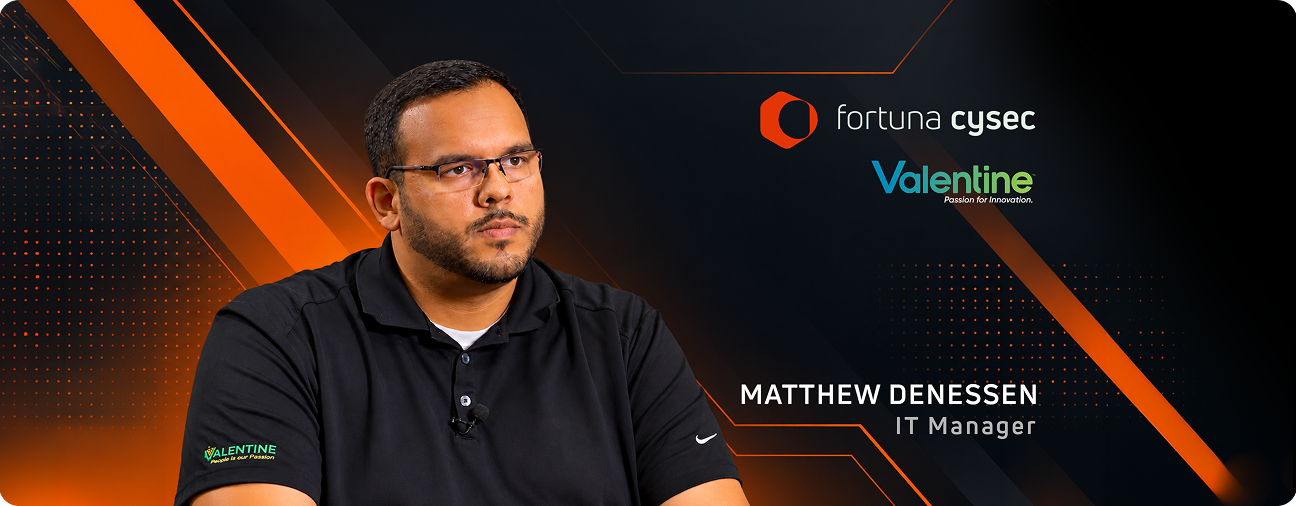
How Valentine Strengthens Its Security Posture with Fortuna Cysec’s Managed IT Security Services

Fortuna Cysec Delivers Scaled Third-Party Risk Management Services for Global Health Tech
ATLANTA, Aug 2026 -- Fortuna Cysec, a global cybersecurity company offering integrated AI-native security operations managed detection and response, continuous threat exposure management and compliance services, today announced it has been selected to provide Third-Party Risk Management services for a leading global health technology company focused on improving patient outcomes through connected care solutions delivered in the home.
The engagement will support vendor onboarding, evidence collection, assessment execution, risk reporting and ongoing platform management across the organization's third-party ecosystem.
Through the partnership, Fortuna Cysec will leverage the partner’s existing environment to streamline third-party risk workflows, drive greater consistency in assessments, and enhance visibility into vendor risk posture. Fortuna Cysec will support approximately 500 third-party risk assessments annually, alongside delivering operational reporting, SLA tracking and governance reviews designed to strengthen transparency and accountability.
The scope of services Fortuna Cysec provides includes rapid vendor engagement, evidence validation, escalation of critical findings and comprehensive risk assessment reporting, enabling organizations to more effectively identify, document and act on third-party risk. The program also incorporates flexible support for M&A activity, audits and demand surges, helping health technology enterprises scale their third-party risk operations as business needs evolve.
“Organizations today need more than tools; they need operational execution that turns risk insights into action,” said Navin Balakrishnaraja, CEO and co-founder of Fortuna Cysec. “We are proud to partner with dynamic global health technology leaders to advance the maturity of their third-party risk programs through scalable, consistent processes that enhance visibility and strengthen governance across their vendor ecosystems. This underscores our commitment to helping regulated and enterprise organizations elevate cybersecurity, vendor risk and governance through hands-on execution, not just advisory support.”
About Fortuna Cysec
Fortuna Cysec is a global cybersecurity company offering Fortunox - an integrated AI-native Security Operations Platform that centralizes AI-powered threat detection, automated response, compliance management and true 24x7 managed detection and response. By combining advanced analytics, automated actions and expert-led response in one integrated system, Fortuna Cysec gives organizations a faster, smarter and more resilient way to defend their environments. For more information, visit www.fortunacysec.com.

Increased Social Engineering attacks targeting the IT Helpdesk
Increased Social Engineering attacks targeting the IT Helpdesk
As per the latest sector alert published by The U.S. Health and Human Services, in coordination with its Health Sector Cybersecurity Coordination Center, advises on having user awareness training, as well as policies and procedures for increased security for identity verification with help desk requests. The threat actors continue to evolve their tactics, techniques, and procedures (TTPs) to achieve their goal which is to gain initial access to target organizations.
Tactics, Techniques, and Procedures used by threat actors
As per the HC3 April 3rd alert social engineering is being used across the Healthcare and Public Health (HPH) sector to gain unauthorized access to systems. Threat actors are employing sophisticated social engineering techniques to target an organization’s IT help desk with phone calls from an area code local to the target organization, claiming to be an employee in a financial role (specifically in revenue cycle or administrator roles).
The threat actor can provide the required sensitive information for identity verification, including the last four digits of the target employee’s social security number (SSN) and corporate ID number, along with other demographic details. These details were likely obtained from professional networking sites and other publicly available information sources, such as previous data breaches.
The threat actor claimed that their phone was broken, and therefore could not log in or receive MFA tokens. The threat actor then successfully convinced the IT help desk to enroll a new device in multi-factor authentication (MFA) to gain access to corporate resources.
After gaining access, the threat actor specifically targeted login information related to payer websites, where they then submitted a form to make ACH changes for payer accounts. Once access has been gained to employee email accounts, they sent instructions to payment processors to divert legitimate payments to attacker-controlled U.S. bank accounts.
The funds were then transferred to overseas accounts. During the malicious campaign, the threat actor also registered a domain with a single-letter variation of the target organization and created an account impersonating the target organization’s Chief Financial Officer (CFO).
Rise in Spearphishing voice
What is Spearphishing?
Phishing can be targeted, known as spearphishing. In spearphishing, a specific individual, company, or industry will be targeted by the adversary.
Spearphishing voice is a specific variant of spearphishing. It is different from other forms of spearphishing in that it employs the use of manipulating a user into providing access to systems through a phone call or other forms of voice communications. Spearphishing frequently involves social engineering techniques, such as posing as a trusted source (impersonation) and/or creating a sense of urgency or alarm for the recipient.
Scattered Spider is a cybercriminal group that has been active since at least 2022 targeting customer relationship management and business-process outsourcing (BPO) firms as well as telecommunications and technology companies. During campaigns, Scattered Spider has leveraged targeted social-engineering techniques and attempted to bypass popular endpoint security tools
They have used several techniques to exploit such as Account Discovery: Cloud Account, Account Discovery: Email Account, Account Manipulation: Additional Cloud Roles, Account Manipulation: Device Registration, Account Manipulation: Additional Cloud Credentials, Data from Cloud Storage, Data from Information Repositories: Sharepoint, Exploit Public-Facing Application, External Remote Services, Gather Victim Identity Information: Credentials, Impersonation, Ingress Tool Transfer, Modify Cloud Compute Infrastructure: Create Cloud Instance, Multi-Factor Authentication Request Generation, Network Service Discovery, Obtain Capabilities: Tool, OS Credential Dumping: DCSync, Permission Groups Discovery: Cloud Groups, Phishing: Spearphishing Voice, Phishing for Information: Spearphishing Voice, Phishing for Information: Spearphishing Service, Protocol Tunneling, Proxy, Remote Access Software, Remote Services: Cloud Services, Valid Accounts: Cloud Accounts, Web Service, Windows Management Instrumentation
How can organizations protect against Spearphishing Voice?
Healthcare organizations and service providers need to implement various detection methods, policies, and procedures to validate the users requesting a password reset or mobile device enrollment.
Helpdesk agents need to employ atmost judgement as the adversary will employ manipulation techniques to bypass the call-back authentication or verification process in place.
Monitor call logs from corporate devices to identify patterns of potential voice phishing, such as calls to/from known malicious phone numbers. Correlate these records with system events.
- Enable logging of events, messaging, and other artifacts provided by third-party services ( ex: metrics, errors, and/or alerts )
- Monitor the events and alerts 24X7X365 using Security Operation Center (SOC)
- Ensure to use of security systems that can tag events from NDR, EDR, SIEM to MITRE ATT&CK framework and are able to predict the later movement quickly
Users can be trained to identify and report social engineering techniques and spearphishing attempts, while also being suspicious of and verifying the identity of callers.
- Train users to be aware of access or manipulation attempts by an adversary to reduce the risk of successful spearphishing, social engineering, and other techniques that involve user interaction.
- Periodic security awareness training and tabletop exercises can help users understand the impact and mitigation procedures.
- Reviewing process and having escalation procedures for confirming incoming requests through an independent platform like a phone call or in-person, to reduce risk.

Benefits of an MSSP
Benefits of an MSSP
Managed Security Services (MSS) are crucial in today's digital landscape to help organizations protect their sensitive information, critical systems, and overall digital assets from an ever-evolving landscape of cyber threats. Cyberattacks are increasing in complexity and sophistication. Here are some reasons why organizations need Managed Security Services:
Expertise and Specialization:
Cybersecurity is a complex and rapidly evolving field. Managed Security Service Providers (MSSPs) are dedicated to staying up to date with the latest threats, vulnerabilities, and defense strategies. They employ a team of skilled cybersecurity professionals with specialized knowledge and experience in handling various security challenges.
24/7 Monitoring and Response:
Cyber threats can occur at any time, day or night. MSSPs offer continuous monitoring of an organization's networks and systems. This 24/7 monitoring ensures that potential threats are identified and addressed in real-time, reducing the risk of data breaches and minimizing downtime.
Advanced Tools and Technologies:
MSSPs utilize advanced security tools, technologies, and threat intelligence platforms that might be cost-prohibitive for individual organizations to implement and manage on their own. This allows organizations to benefit from cutting-edge security solutions without the need for significant upfront investments.
Scalability:
As organizations grow, their security needs also evolve. MSSPs offer scalability, allowing organizations to easily adjust the level of security services based on their changing requirements without having to invest in new infrastructure or hire additional personnel.
Cost Efficiency:
Building an in-house cybersecurity team and infrastructure can be expensive. It requires recruiting, training, and retaining skilled cybersecurity professionals, as well as investing in hardware, software, and ongoing maintenance. MSSPs offer a more cost-effective solution, as organizations pay for the services they need without the overhead of managing an internal security team.
Focus on Core Business Activities:
Managing cybersecurity internally can be resource-intensive and distract organizations from their core business objectives. By outsourcing security to MSSPs, organizations can free up their internal resources to focus on strategic initiatives that drive growth and innovation.
Compliance and Regulations:
Many industries are subject to strict regulatory requirements regarding data protection and cybersecurity. MSSPs have experience in navigating these compliance frameworks and can help organizations ensure that they meet the necessary standards.
Rapid Incident Response:
In the event of a security incident or breach, MSSPs have established incident response protocols and teams ready to mitigate the damage and guide the organization through the recovery process.
Risk Management:
MSSPs provide organizations with a comprehensive understanding of their security posture and vulnerabilities. This enables organizations to make informed decisions about risk mitigation strategies and allocate resources effectively.
Threat Intelligence:
MSSPs gather threat intelligence from a wide range of sources, allowing them to identify emerging threats and trends. This proactive approach helps organizations stay ahead of potential attacks and adapt their security measures accordingly.
In summary, Managed Security Services offer organizations the advantage of specialized expertise, round-the-clock protection, advanced tools, scalability, cost savings, and the ability to focus on core business activities. As cyber threats become more sophisticated and prevalent, many organizations find that partnering with MSSPs is a strategic way to enhance their overall cybersecurity posture.
Fortuna Cysec Named a CRN’s 2026 Best of the Channel Awards Finalist for Best Security Solution Provider of the Year
Fortuna Cysec Named a CRN’s 2026 Best of the Channel Awards Finalist for Best Security Solution Provider of the Year
ATLANTA, Aug. 18, 2026 -- Fortuna Cysec, a global cybersecurity company offering integrated AI-native security operations managed detection and response, continuous threat exposure management and compliance services, has been recognized as a finalist by CRN®, a brand of The Channel Company, for its second annual CRN Best of the Channel Awards in category of the “Best Security Solution Provider of the Year.”
As a finalist, Fortuna Cysec is being spotlighted for its dedication to channel innovation and excellence through helping organizations across multiple regulated and risk-sensitive sectors with their managed security, risk mitigation, compliance advisory, incident response, vulnerability management, and security operations services.
As a global security-first solution provider, Fortuna Cysec allows organizations overwhelmed by disconnected products, alert fatigue, compliance obligations, and limited internal security resources to move beyond fragmented security tools towards measurable security outcomes. Its integrated AI-native Security Operations Platform Fortunox, offers a unified, managed approach to cybersecurity by combining visibility, detection, response, remediation, compliance reporting, and executive-level risk insight into asingle operating model. This includes 24X7 managed detection and response, Continuous Threat Exposure Management (CTEM) and compliance services, supporting both technical execution and risk guidance needs.
The CRN Best of the Channel Awards honors individual leaders, teams, and companies setting an example with theirvisionary strategies and outstanding contributions to channel success.
“The finalists of the CRN Best of the Channel Awards represent the very best of the IT channel," said Jennifer Follett, VP, U.S. Content and Executive Editor of CRN, The Channel Company. "Through innovation, exceptional leadership, and an unwavering commitmentto partners and customers, these individuals, teams, and companies are helping shape the future of the channel. We are proud to recognize their accomplishments and the lasting impact they continue to make across the industry."
“We are honored to be recognized as a finalist among such an impressive group of innovators,” said Navin Balakrishnaraja, CEO and co-founder of Fortuna Cysec. “This recognition highlights the strength of our platform and our team’s commitment to helping clients reduce risk, strengthen resilience, and mature their security and compliance programs.”
Winners will be announced at the Best of the Channel Awards Gala in Atlanta on Oct. 13, immediately following The Channel Company’s XChange Best of Breed Conference. To see the full list of CRN Best of the Channel Award finalists, visit crn.com/best-of-the-channel-awards.
About Fortuna Cysec
Fortuna Cysec is a global cybersecurity company offering Fortunox - an integrated AI-native Security Operations Platform that centralizes AI-powered threat detection, automated response, compliance management and true 24x7 managed detection and response. By combining advanced analytics, automated actions and expert-led response in one integrated system, Fortuna Cysec gives organizations a faster, smarter and more resilient way to defend their environments. For more information, visit www.fortunacysec.com.
About The Channel Company
The Channel Company (TCC) is the global leader in channel growth for the world's top technology brands. We accelerate success across strategic channels for tech vendors, solution providers, and end users with premier media brands, integrated marketing and event services, strategic consulting, and exclusive market and audience insights. TCC is a portfolio company of investment funds managed by Eagle Tree Capital, a New York City-based private equity firm. For more information, visit thechannelco.com.
FollowThe Channel Company: LinkedIn, X
©2026 The Channel Company, Inc. The Channel Company logo is a registeredtrademark of The Channel Company, Inc. All other trademarks and trade names arethe properties of their respective owners. All rights reserved.
The Channel Company Contact:
Lindsay Sawyer, The Channel Company lsawyer@thechannelcompany.com


Fortuna Cysec Appoints Srinivas Pendela as Vice President of Service Delivery to Accelerate Global Growth and Customer Success
Fortuna Cysec Appoints Srinivas Pendela as Vice President of Service Delivery to Accelerate Global Growth and Customer Success
ATLANTA, Aug. 6, 2026 -- Fortuna Cysec, a global cybersecurity company offering integrated AI-native security operations managed detection and response, continuous threat exposure management and compliance services, today announced the appointment of Srinivas Pendela as Vice President of Service Delivery, reinforcing the company's commitment to delivering exceptional customer outcomes, operational excellence, and scalable cybersecurity and managed services worldwide.
A proven technology leader, Srinivas Pendelabrings more than 21 years of experience in infrastructure, cloud,cybersecurity, and IT service operations, leading global service delivery andtransformation initiatives across North America, Europe, Canada, and India. Risingfrom network engineer to senior technology executive, he has successfully ledlarge-scale 24x7 operations, cross-functional teams, and enterprise servicedelivery programs spanning cloud, infrastructure, cybersecurity, automation,digital transformation, customer success, and presales strategy. Throughout hiscareer, he has driven multimillion-dollar digital transformation and managedservices programs while championing AI-driven automation initiatives thatimproved operational efficiency and enhanced service delivery.
“I’m excited to join Fortuna Cysec at such apivotal time in its growth journey," said Pendela. “Organizations todayare looking for trusted partners that can help them navigate increasinglycomplex cybersecurity challenges while maximizing the value of their technologyinvestments. I look forward to working with our talented team to furtherelevate service delivery, strengthen customer relationships, and buildscalable, innovative solutions that help our clients achieve their security andbusiness objectives."
In his new role, Srinivas will help lead andscale Fortuna Cysec's service delivery organization, enhancing operationalexcellence, customer outcomes, and service innovation as the company continuesto expand its global footprint. His leadership will support Fortuna Cysec'sgrowing portfolio of cybersecurity consulting, managed security services, andAI-powered solutions, enabling organizations to strengthen security operations,reduce cyber risk, and improve resilience.
“Srinivas brings a rare combination ofoperational excellence, technical expertise, and customer-first leadership thataligns perfectly with our vision,” said Navin Balakrishnaraja, CEO andco-founder of Fortuna Cysec. “As we continue expanding our cybersecuritysolutions, his experience leading global teams and driving servicetransformation will be instrumental in helping us scale efficiently, accelerateinnovation, and deliver even greater value to our customers. We are thrilled towelcome him to the leadership team.”
This announcement follows Fortuna Cysec’srecent enhancements to Fortunox, thecompany’s unified, configurable, managed cybersecurity platform designed forregulated industries that centralizes an organization's security posture forall assets across all locations. The latest enhancements are helping organizationsmore effectively operationalize their Continuous Threat Exposure Management(CTEM) while maximizing the value of existing security investments and tools.
About Fortuna Cysec
Fortuna Cysec is a global cybersecurity companyoffering Fortunox - an integrated AI-native Security Operations Platform thatcentralizes AI-powered threat detection, automated response, compliancemanagement and true 24x7 managed detection and response. By combining advancedanalytics, automated actions and expert‑led response in one integrated system,Fortuna Cysec gives organizations a faster, smarter andmore resilient way to defend their environments. For more information, visit www.fortunacysec.com.

Either You Need a New Integrated Partner, or Your MSP Does
An examination of how disconnected MSP and MSSP relationships create dangerous security gaps—and why organizations need an integrated partner that connects detection, remediation, business context, and accountability.
For years, many organizations have relied on their Managed Service Provider to keep their technology running. MSPs handle helpdesk tickets, device management, patching, Microsoft 365 administration, backups, networking, and the day-to-day operational needs that keep a business moving.
But cybersecurity has changed.
Today’s threats move faster, target more parts of the environment, and require deeper expertise than traditional IT support alone was designed to provide. As a result, many MSPs eventually reach a point where they realize they need help. They acknowledge that they are not a 24×7 security operations center, so they outsource security monitoring to a third-party MSSP or SOC provider.
On the surface, that sounds like the right move.
In practice, the standard MSP/MSSP relationship often creates a dangerous gap for the end customer.
The Problem With the Traditional MSP/MSSP Model
The typical model looks like this:
- The MSP manages the client’s IT environment.
- The MSSP monitors alerts.
- The SOC detects, correlates, and validates threats.
- Then, when something is confirmed, the issue is often handed back to the MSP to fix.
- That handoff is where the problem begins.
The MSP already recognized that security was not their strongest capability. That is why they outsourced SOC services in the first place. But when a real incident occurs, when the threat is active, the environment is under pressure, and speed matters most, the responsibility frequently shifts back to the same team that admitted they needed outside security support.
That creates a critical issue at a critical time.
Detection alone is not enough. Correlation alone is not enough. Even response alone may not be enough if the team responsible for remediation does not understand the security context, business impact, root cause, and urgency behind the threat.
The result is often delay, confusion, and incomplete resolution.
The Handoff Problem Is Bigger Than Most Customers Realize
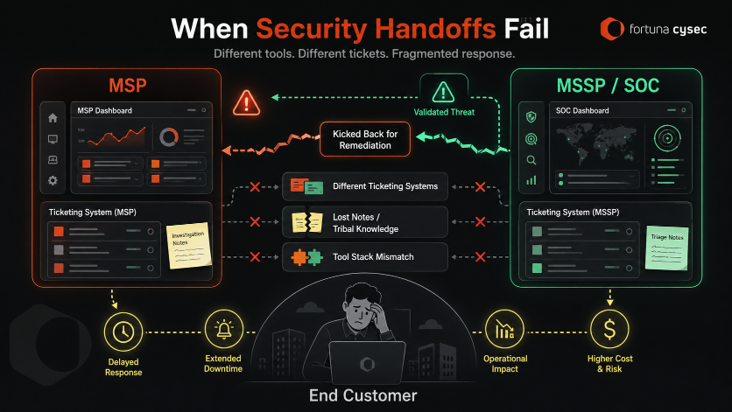
One of the biggest deficiencies in the traditional MSP/MSSP model is that the handoff is rarely seamless.
- The MSP may live in one ticketing system.
- The MSSP may operate in another.
- The customer may have their own system entirely.
When those systems are not tightly integrated, critical handling notes, escalation history, environmental details, and tribal knowledge do not move cleanly between teams. The SOC may validate a threat but lack visibility into previous issues on that device. The MSP may receive a ticket but not fully understand the investigation trail, the severity rationale, or the attacker behavior that triggered the escalation.
This matters because during a security event, context is everything.
A note buried in one system may explain that a server supports a critical business unit. A previous ticket may reveal that a device has recurring patch failures. A technician may know that a certain user travels frequently, works remotely, or has privileged access. A SOC analyst may know that an alert is tied to a broader attack pattern.
When that information is scattered across separate systems and separate teams, the customer loses speed and clarity at the exact moment they need both.
This creates a security model built around ticket passing instead of risk reduction.
Tool Stack Lock-In Creates Another Problem
The other challenge is the tool stack.
In many MSP/MSSP relationships, the customer is forced into whatever security tools the MSP or MSSP has already selected. The model is built around provider convenience, not necessarily customer need.
That may create operational efficiency for the provider, but it can create limitations for the customer.
- The MSP may only support certain endpoint tools.
- The MSSP may only monitor certain logs.
- The SOC may only integrate with a preferred SIEM, EDR, or ticketing platform.
- The customer’s existing investments may be ignored, replaced, or underutilized.
This can leave organizations trapped in an inflexible model where their actual business needs are not fully surfaced. Instead of asking, “What does this customer need based on their risk, operations, compliance requirements, and maturity level?” the model becomes, “Here is the stack we use, and here is how you fit into it.”
That is backwards.
Security tools should support the customer’s operating model. The customer should not have to reshape their security program around the limitations of disconnected providers.
A stronger model should be flexible enough to work with the customer’s environment, integrate with the tools that already matter, and recommend changes based on risk and maturity — not just vendor preference.
The End Customer Pays the Price
From the end customer’s perspective, this fragmented model can be frustrating and risky.
- One provider sees the alert.
- Another provider manages the endpoint.
- Another team owns the firewall.
- A different ticketing system holds the notes.
- A separate platform contains the security investigation.
- The business leader just wants to know: are we safe, what happened, what matters, and what are we doing about it?
When security responsibility is split across disconnected teams, the customer is left managing the seams between providers. During a normal support issue, that may be inefficient. During a cyber event, it can be dangerous.
Common failure points include:
- Delayed remediation because the SOC identifies the issue but does not own the fix.
- Incomplete response because the MSP receives an alert without enough security context.
- Lost tribal knowledge because ticketing systems, notes, and escalation histories are not shared effectively.
- Tool limitations because the customer is forced into a provider-selected stack instead of a model built around their needs.
- Poor prioritization because neither party fully understands which systems, users, data, or business units matter most.
- Recurring incidents because the immediate threat is closed, but the root cause is never fully addressed.
- Executive confusion because reporting focuses on alerts and tickets instead of risk reduction, resilience, and business impact.
This is how organizations end up with activity but not maturity. Lots of alerts. Lots of tickets. Lots of dashboards. But not enough actual reduction in exposure, risk, or threat impact.
Security Requires Environmental Intimacy
Strong cybersecurity is not just about tools. It is not just about having a SOC. It is not just about alert triage.
It requires intimacy with the environment.
A mature security partner should understand your infrastructure, users, business units, critical systems, sensitive data, compliance obligations, operational workflows, and risk tolerance. They should know what matters most to the business, not just what appears most severe in a generic alert queue.
That context changes everything.
A vulnerability on a dormant test system is different from a vulnerability on a system that supports patient care, financial transactions, manufacturing operations, or executive communications. A suspicious login from a normal user is different from a suspicious login from a privileged administrator. A malware alert on a standard workstation is different from an alert tied to a device with access to regulated data.
Without business context, security teams can only react to technical signals.
With business context, they can prioritize, respond, remediate, and mature the environment over time.
The Goal Should Be Maturity, Not Just Monitoring
Many organizations think they are buying security when they purchase SOC monitoring. What they are often buying is visibility into potential threats.
Visibility is important, but it is only the starting point.
The real goal should be to raise the organization’s security maturity level. That means reducing the number of recurring issues, improving response readiness, hardening weak points, prioritizing risk based on business impact, and helping leadership make better decisions.
A mature security operating model should include:
- Continuous visibility across assets, users, vulnerabilities, identities, systems, and sensitive data.
- Risk-based prioritization that goes beyond alert severity or CVSS scores.
- Shared operational context across security, IT, ticketing, remediation, and reporting workflows.
- Flexible tool integration that supports the customer’s environment instead of forcing the customer into a rigid provider stack.
- Coordinated response that connects detection, investigation, containment, remediation, and validation.
- Root-cause analysis to understand why an incident happened and how to prevent it from recurring.
- Executive-level reporting that shows risk reduction, operational improvement, and business impact.
- Remediation support so the customer is not left holding the bag after an alert is validated.
That is the difference between a vendor that watches your environment and a partner that helps improve it.
Either You Need a New Integrated Partner, or Your MSP Does
This does not mean MSPs are the problem. Many MSPs are excellent operational technology partners. They are close to their clients, understand day-to-day IT needs, and play an essential role in keeping businesses running.
But the traditional MSP/MSSP handoff model is no longer enough.
If your MSP is not built to deliver mature cybersecurity outcomes, they need an integrated security partner behind them. If your current provider structure creates handoffs, disconnected ticketing, lost tribal knowledge, tool limitations, or delayed remediation during security events, then your business may need a new model altogether.
The best outcome is not an MSP on one side and an MSSP on the other, with the customer stuck in the middle.
The best outcome is an integrated operating model where security expertise, IT context, remediation capability, business risk awareness, ticketing visibility, and tool flexibility work together.
- That is how organizations reduce threat impact.
- That is how they mature their security program.
- That is how they move from reactive support to resilient operations.
Because when something happens, the question should not be, “Who owns this?”
The answer should already be clear.

Cybersecurity Needs an Immune System, Not a Pile of Disconnected Tools
An exploration of why disconnected cybersecurity tools create noise, duplication, and slower response—and how a coordinated, risk-informed security ecosystem can improve resilience, accountability, and outcomes.
The human body is one of the most sophisticated defense systems ever created.
It does not rely on one control. It does not depend on one sensor. It does not wait for a single alert before deciding whether something is dangerous. The immune system is a coordinated, layered, adaptive defense model that constantly monitors, communicates, prioritizes, responds, learns, and heals.
Now imagine if the body worked the way many cybersecurity programs do today.
Imagine if the skin detected a cut, but could not notify the bloodstream. Imagine if white blood cells saw an infection, but had no way to communicate with the brain. Imagine if inflammation continued long after the threat was gone because no one told the body the incident had been resolved. Imagine if the immune system had five different tools identifying the same infection, but none of them agreed on severity, location, or next steps.
The body would fail.
Not because it lacked defenses, but because those defenses were fragmented.
That is the problem facing many organizations today. They do not lack cybersecurity tools. In fact, many have too many. Endpoint protection, firewalls, vulnerability scanners, SIEMs, identity tools, email security, cloud security, compliance platforms, ticketing systems, backup systems, and managed service providers all generate signals. Each tool may be valuable on its own, but when these systems do not speak to one another, the organization is left with noise instead of clarity.
The result is a security program that looks strong on paper but struggles in practice.
Alerts pile up. Vulnerabilities remain unresolved. Duplicate tools create overlapping costs. Teams chase the same issue from multiple consoles. Executives receive reports that describe activity, but not necessarily risk. Security teams are asked to prioritize thousands of findings without enough business context to know which exposures matter most.
In the human body, defense depends on coordination. Cybersecurity should be no different.
The Problem With Tool Stacking
For years, many organizations responded to cyber risk by adding more tools. A new threat emerged, so a new platform was purchased. A new compliance requirement appeared, so another dashboard was added. A new gap was identified, so another vendor was brought in.
Over time, the security environment became crowded.
This created a new kind of risk: operational fragmentation.
Tool stacking often leads to redundant capabilities, duplicated alerts, inconsistent reporting, and unclear ownership. One system may detect suspicious activity. Another may identify the vulnerable asset. A third may know the user has elevated privileges. A fourth may understand that sensitive data is present. A fifth may open the ticket. But if those systems are not connected through a common operating model, the organization still has to manually determine what matters, who owns it, and what should happen next.
That is not maturity. That is complexity.
The issue is not that these tools are bad. Many are excellent. The issue is that tools alone do not create security outcomes. Just as the body needs coordination between detection, communication, response, and recovery, cybersecurity needs an ecosystem that connects signals to decisions and decisions to action.
Alerts Are Not the Same as Immunity
A fever is not the immune system. It is a signal.
In the same way, an alert is not a security outcome. It is the beginning of a decision process.
Too many cybersecurity programs are built around alert generation instead of risk reduction. A SIEM receives logs. An EDR tool flags behavior. A vulnerability scanner produces findings. A compliance platform identifies gaps. Each system creates more information, but more information does not automatically mean better protection.
The real question is: What happens next?
Does the organization know whether the affected system is business-critical? Does it know whether sensitive data is exposed? Does it know whether the vulnerability is actively exploitable? Does it know whether the user involved has privileged access? Does it know whether the issue has appeared before? Does it know who owns remediation? Does it validate that the fix actually worked?
If not, the organization does not have a security immune system. It has a collection of disconnected alarms.
Redundancy Can Be Useful — Until It Becomes Waste
The human body has redundancy by design. Multiple layers of defense exist because survival requires backup. Skin, mucus membranes, inflammation, antibodies, white blood cells, and memory cells all play different roles.
But biological redundancy is coordinated. It is not random.
In cybersecurity, redundancy can be valuable when controls reinforce one another. But redundancy becomes waste when multiple tools perform overlapping functions without improving visibility, response, or risk reduction. Organizations may pay for the same capability more than once across endpoint tools, cloud platforms, identity systems, SIEMs, MDR providers, compliance platforms, and vulnerability tools.
This creates two problems.
First, the organization overpays for duplicate features.
Second, the security team may still lack a unified view of risk.
That is the worst of both worlds: higher cost and lower clarity.
A mature cybersecurity ecosystem should help organizations understand which tools are delivering value, which capabilities overlap, and where integration can improve outcomes without unnecessary rip-and-replace disruption.
The AI Era Raises the Stakes
The rise of AI-driven attack techniques makes interoperability even more important.
AI can accelerate reconnaissance, phishing, social engineering, malware development, vulnerability research, and attack automation. It can also increase the speed and volume of activity security teams must review. As attackers use automation to move faster, defenders cannot afford to operate through disconnected workflows and manual handoffs.
A fragmented security program will struggle in this environment.
If identity risk is separate from endpoint detection, if vulnerability context is separate from incident response, if sensitive data exposure is separate from asset criticality, and if ticketing is separate from validation, then the organization loses time. In cybersecurity, lost time often means increased exposure.
AI does not eliminate the need for human judgment. It increases the need for a better operating model. Security teams will need systems that can correlate context, reduce noise, prioritize risk, recommend action, and support faster response. But those capabilities are only useful if they are part of an interoperable ecosystem.
The future of cybersecurity is not just more AI. It is better coordination between people, process, tools, telemetry, automation, and business risk.
Fortunox as a Cybersecurity Immune System
Fortunox by Fortuna Cysec was built around this principle.
Rather than treating cybersecurity as a pile of separate tools, Fortunox is designed as a managed security operations ecosystem. It brings together detection, response, exposure management, identity-aware risk context, compliance reporting, remediation workflows, and executive visibility into a coordinated model.
Like the immune system, Fortunox is designed to help organizations detect signals, understand severity, prioritize response, coordinate action, and validate recovery.
On the proactive side, Fortunox supports Continuous Threat Exposure Management by helping organizations move beyond raw vulnerability counts and CVSS scores. It considers exploitability, asset criticality, sensitive data exposure, identity risk, and business impact so teams can focus on the exposures that create the greatest organizational risk.
On the reactive side, MDR+ helps organizations move beyond monitor-and-notify security. Detection is only one part of the process. The real value comes from triage, investigation, containment, root-cause analysis, remediation support, validation, and hardening over time.
That is the difference between alerting and immunity.
Alerting tells you something happened.
An immune-system model helps determine what it means, how serious it is, what should happen next, whether the issue has been resolved, and how to prevent the same problem from recurring.
Bring Your Own Stack, But Make It Work Together
One of the most important realities in cybersecurity is that organizations already have tools. They have made investments. They have existing systems, contracts, workflows, and operational preferences. Asking every organization to rip and replace its environment is often unrealistic.
That is why Fortunox supports a Bring Your Own Stack model.
The goal is not to force every client into one rigid technology stack. The goal is to help the organization make its existing stack work better. Endpoint, firewall, identity, cloud, ticketing, infrastructure, vulnerability, and compliance tools can all contribute important signals. The key is connecting those signals into a managed operating model that improves prioritization, response, reporting, and accountability.
This is especially important for regulated industries such as healthcare, financial services, insurance, manufacturing, and other compliance-driven sectors. These organizations need more than dashboards. They need defensible evidence, clear ownership, measurable improvement, and a partner that can help reduce risk over time.
The Goal Is Not More Noise. It Is Better Defense.
The immune system does not win by creating endless alerts. It wins by recognizing what matters, responding appropriately, learning from exposure, and restoring the body to health.
Cybersecurity programs should aim for the same outcome.
A mature security program should not simply generate more findings. It should reduce unnecessary noise, eliminate duplicate effort, focus attention on the highest-risk issues, validate remediation, and help the organization become more resilient over time.
That requires interoperability.
It requires context.
It requires accountability.
And it requires a model that connects tools, people, processes, and business risk into one coordinated defense system.
The cybersecurity landscape is entering a new era. AI-driven attack vectors, expanding digital environments, tighter compliance requirements, and persistent staffing shortages will continue to pressure organizations. The answer cannot simply be another disconnected tool.
The answer is a security immune system.
That is the role Fortunox is designed to play: helping organizations move from fragmented tool stacking to coordinated, risk-informed, managed cyber defense.
How Valentine Strengthens Its Security Posture with Fortuna Cysec’s Managed IT Security Services
As organizations depend increasingly on digital systems to support their business operations, maintaining a strong security posture becomes essential. Managing security technologies, responding to emerging threats, and maintaining consistent protection can require specialized expertise and ongoing resources.
Heading 1
Heading 2
Heading 3
Heading 4
Heading 5
Heading 6
Lorem ipsum dolor sit amet, consectetur adipiscing elit, sed do eiusmod tempor incididunt ut labore et dolore magna aliqua. Ut enim ad minim veniam, quis nostrud exercitation ullamco laboris nisi ut aliquip ex ea commodo consequat. Duis aute irure dolor in reprehenderit in voluptate velit esse cillum dolore eu fugiat nulla pariatur.
Block quote
Ordered list
- Item 1
- Item 2
- Item 3
Unordered list
- Item A
- Item B
- Item C
Bold text
Emphasis
Superscript
Subscript

Fortuna Cysec helps Extended Care Facility increase its security and privacy posture
A Lifespan community in South East US with more than 800 residents in its various facilities which include Independent Living (IL), Assisted Living (AL), Skilled Nursing home (SNF) and Memory Care.
Heading 1
Heading 2
Heading 3
Heading 4
Heading 5
Heading 6
Lorem ipsum dolor sit amet, consectetur adipiscing elit, sed do eiusmod tempor incididunt ut labore et dolore magna aliqua. Ut enim ad minim veniam, quis nostrud exercitation ullamco laboris nisi ut aliquip ex ea commodo consequat. Duis aute irure dolor in reprehenderit in voluptate velit esse cillum dolore eu fugiat nulla pariatur.
Block quote
Ordered list
- Item 1
- Item 2
- Item 3
Unordered list
- Item A
- Item B
- Item C
Bold text
Emphasis
Superscript
Subscript


Fortuna Cysec helps Healthcare Organization protect sensitive patient health information through robust cybersecurity measures
Working with the acute care facility’s IT security team Fortuna Cysec was able to assess the implemented solutions, find gaps in the implementations, bring best practices and discuss with the team.
Heading 1
Heading 2
Heading 3
Heading 4
Heading 5
Heading 6
Lorem ipsum dolor sit amet, consectetur adipiscing elit, sed do eiusmod tempor incididunt ut labore et dolore magna aliqua. Ut enim ad minim veniam, quis nostrud exercitation ullamco laboris nisi ut aliquip ex ea commodo consequat. Duis aute irure dolor in reprehenderit in voluptate velit esse cillum dolore eu fugiat nulla pariatur.
Block quote
Ordered list
- Item 1
- Item 2
- Item 3
Unordered list
- Item A
- Item B
- Item C
Bold text
Emphasis
Superscript
Subscript