Fortuna helps organizations turn disconnected security findings into a continuous, business-aligned exposure-reduction program.
Our CTEM service combines expertise, technology, cross-functional coordination, remediation, and validation to shorten the window of exposure and measurably reduce organizational risk.
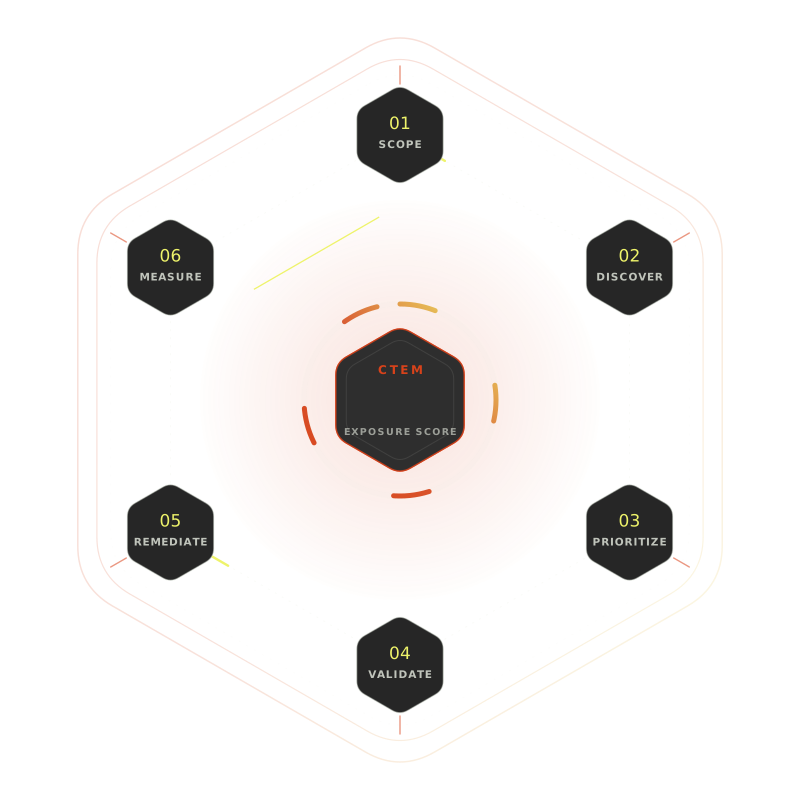

Shorter Exposure Window, (not just faster detection)

Business-context prioritization, (not just raw severity scores)

Verified remediation closure, (not just ticket closure)
Continuous Threat Exposure Management is an operating framework, not another security tool. CTEM creates a repeatable process for continuously identifying, evaluating, prioritizing, validating, and reducing the exposures most likely to affect the organization.
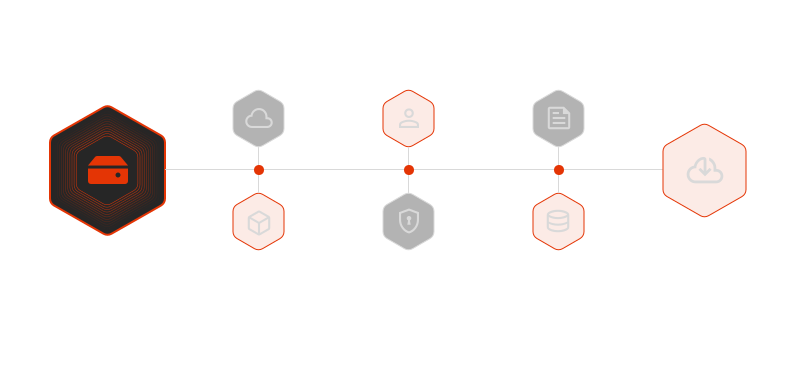
The process brings security, IT, infrastructure, application owners, compliance, and business leadership together.
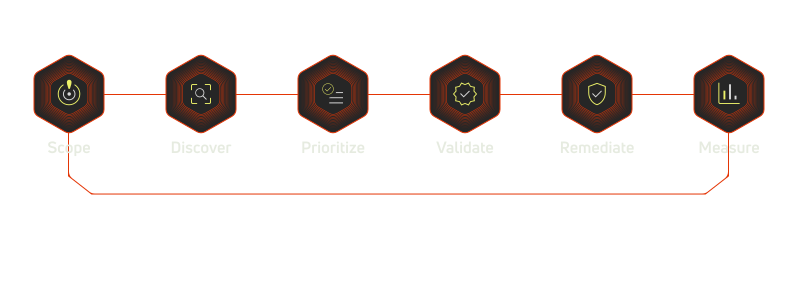
The goal is straightforward: reduce the time exposures remain open and decrease the likelihood and potential impact of an attack.

Most organizations do not have a shortage of security findings. They have more findings than they can realistically address. Vulnerability scanners, cloud platforms, endpoint tools, identity systems, and security products continuously generate issues—but those findings often lack the context required to determine what should be fixed first.

Traditional severity scores do not fully account for:

Security may identify the issue, while infrastructure, application teams, MSPs, cloud administrators, or business owners are responsible for resolving it.
Tickets are created, but ownership, deadlines, exceptions, escalation, and closure validation are often inconsistent.

Buying another platform may generate additional findings and dashboards without establishing the governance, processes, accountability, and remediation capability required to reduce exposure.
Fortuna Cysec implements and operates a complete CTEM program powered by the Fortunox platform. We begin by establishing the operating model—not by replacing the technology you already use.
Fortuna Cysec works with stakeholders to define the operating model and program governance before any technology work begins.
Fortunox integrates findings from the client’s current security and IT tools, including vulnerability scanners, endpoint platforms, cloud systems, identity tools, SIEM, RMM, and ITSM platforms.
Fortunox correlates nine signal types to produce a calculated Fortunox CTEM Risk Rating, helping teams focus on the exposures most likely to be exploited and most damaging to the organization.
Correlated signals funnel into the Fortunox CTEM Risk Rating, then flow into the client’s ITSM processes and SOC detection and response workflows.

CVSS scores and scan findings across assets, applications, and cloud services.

Availability of malicious code able to take advantage of misconfigurations and vulnerabilities.

Whether sensitive or regulated information resides on the device—and whether it is encrypted.

The value of the asset to the organization and the business services it supports.
Prioritized exposures are documented and managed through the client’s ITSM or ticketing platform. Resolution paths may include:
Fortunox risk intelligence can also be incorporated into SOC threat detection and incident response workflows.
Fortuna Cysec supports the full exposure lifecycle.
Consolidate exposures across available security, infrastructure, cloud, identity, and data sources.
Apply threat, business, asset, data, and control context to determine what matters most.
Establish a named owner, required action, target date, and escalation path.
Coordinate with internal IT, application owners, MSPs, or cloud teams. Managed Remediation clients can authorize Fortuna to perform approved patching and configuration changes directly.
Re-scan and verify that the exposure was actually reduced—not simply that a ticket was closed.
Report on open risk, remediation progress, exceptions, exposure trends, and measurable improvement over time.


Fortuna Cysec delivers expertise, program implementation, technology integration, ongoing management, and remediation support as one coordinated service.
of breaches now begin with vulnerability exploitation.
Verizon reports that vulnerability exploitation has surpassed stolen credentials as the leading breach entry point and that AI is accelerating exploitation from months to hours.
Reduce the time between exposure discovery and verified remediation—not simply the time required to identify or ticket the issue.
of published vulnerabilities typically show exploitation activity within a 30-day period.
Vulnerabilities are not equally likely to be exploited. Treating every High or Critical finding the same can consume remediation resources without producing proportional risk reduction.
Focus limited remediation capacity on exposures based on exploit likelihood, active threat activity, business impact, asset criticality, sensitive data and compensating controls.
is the bridge between identifying exposure and actually reducing it.
Gartner's CTEM model emphasizes mobilization because remediation commonly crosses organizational boundaries and can be slowed by siloed teams, inconsistent ownership and operational constraints.
Security may identify the exposure, while infrastructure, cloud, application, compliance or business teams own the resolution. CTEM establishes ownership, accountability, escalation and a coordinated path to closure.
Exposure includes more than software vulnerabilities.
CISA and NSA have identified recurring security misconfigurations that create systemic weaknesses even in organizations with mature cybersecurity programs.
Understand vulnerabilities alongside misconfigurations, exposed assets and services, identity and privilege risks, sensitive data exposure and ineffective or missing security controls.
Closed does not necessarily mean fixed.
NIST defines enterprise patch management as identifying, prioritizing, acquiring, installing and verifying patches and updates.
Remediation should be re-scanned and validated so you know the exposure was actually removed or reduced—not simply marked complete in a ticketing system.
Security activity only matters when it produces measurable risk reduction.
NIST CSF 2.0 emphasizes understanding, assessing, prioritizing and communicating cybersecurity risk while continuously evaluating and improving the organization's security posture.
Leadership gains visibility into exposure trends, remediation progress, exposure dwell time, exceptions, service-level performance and validated risk reduction—not simply vulnerability counts.
At the end of every CTEM cycle, your organization should be able to show more than the number of findings identified or tickets closed.
You should be able to demonstrate that priority exposures were resolved, the window of exposure became shorter, and measurable organizational risk was reduced.
Talk to our experts to get One Managed Platform for all your cybersecurity needs.



In today's rapidly evolving digital landscape, safeguarding your data's safety and integrity is paramount.
Our security services are SOC 2 Type 2 certified, setting a new standard for excellence and reliability in safeguarding your valuable information. This certification underscores our commitment to upholding the highest standards in security practices, ensuring that our systems are designed to protect against unauthorized access, data breaches, and other potential risks.
This certification signifies that we meet all five of the American Institute of Certified Public Accountants (AICPA) Trust Services Criteria concerning internal controls relevant to security, availability, processing integrity, confidentiality, and privacy.
• Heightened Security: With SOC 2 Type 2 certification, rest assured that our security protocols are not just established but consistently reliable over time.
• Regulatory Compliance: Our adherence to SOC 2 Type 2 standards guarantees that we fulfill rigorous criteria for the security, availability, processing integrity, confidentiality, and privacy of your data.
• Assurance: Trust in our capability to protect your sensitive data grants you peace of mind, allowing you to focus on your core business activities without worrying about security concerns.
At Fortuna Cysec, we recognize the significance of trust and transparency in security. Our attainment of SOC 2 Type 2 certification reaffirms our steadfast dedication to providing exceptional security solutions to our valued clients.

